Troubleshooting
Use this page from the failure point outward. The most common problems in the supplied environment were ownership/project mismatches, pending agents, Keycloak JWT trust configuration, scope configuration, and user matching.
Agent cannot complete authorization
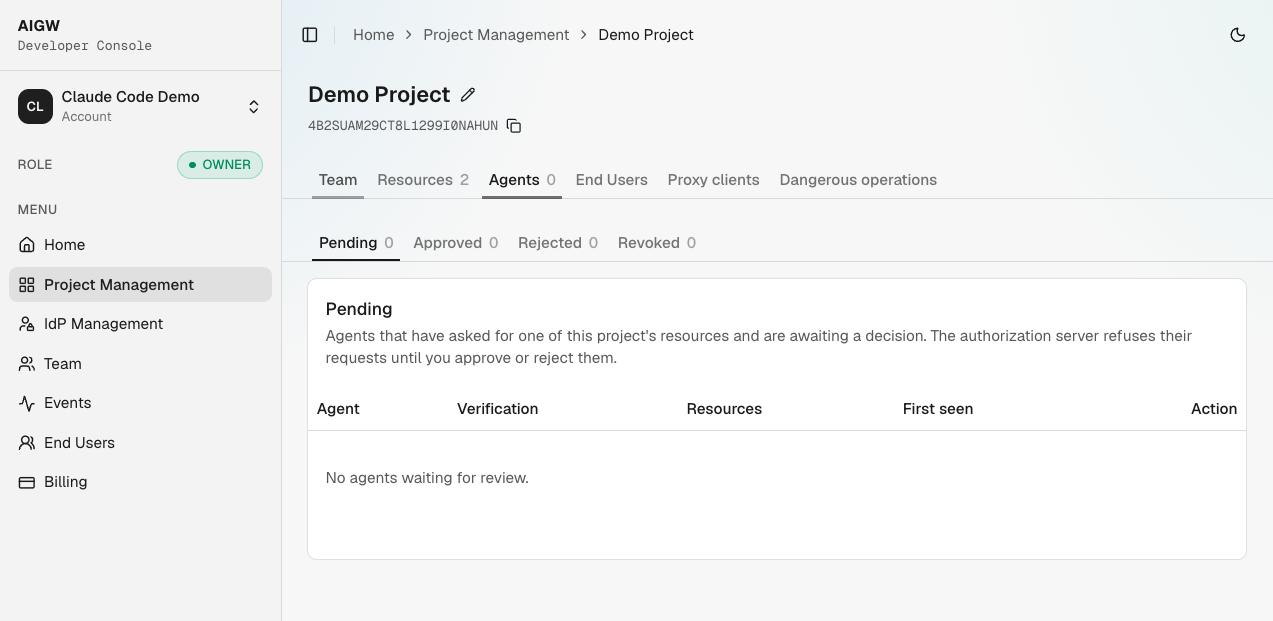
Check: ProjectProjectThe isolation boundary for an integration. It holds Resources, agents and agent policy, end users, and Proxy clients. → Agents. A newly registered agent may be Pending, Rejected, or Revoked. The system default approves every agent, so if an agent is held or rejected, check Agents → Approval rulesApproval rulesThe part of Agent policy that sets Approve, Hold, or Reject for unverified agents and for each kind of agent proof. (Project default and per-Resource overrides) and KYA issuersKYA issuersThe per-Project (or per-Resource) whitelist of KYA credential issuers AIGW accepts, each with a minimum trust level.; the Decided by column shows whether policy or a person made the decision. See Agent policy.
Also verify redirect URI, PKCEPKCEProof Key for Code Exchange: binds an authorization request to the later code exchange so a stolen code is useless. state/verifier, requested scopes, and that the ResourceResourceThe downstream system registered in a Project. Its kind (Token exchange or OAuth client) decides the role AIGW plays. authorization endpoint (not only the core endpoint returned in some DCRDCRDynamic Client Registration (RFC 7591): an agent registers itself as an OAuth client at runtime, with no manual setup. metadata) is being used.
DCR fails
Check:
- every redirect URI is absolute HTTPS;
- no unsupported Resource scope is sent in the registration body;
grant_types/response_typesmatch the supported OAuth flow.
Agent gets a token, but MCP/UCP redemption fails
Check:
Authorization: Bearer <AIGW token>is present;X-Proxy-Tokenis present;- Proxy clientProxy clientThe server-side credential (client ID and secret) the MCP/UCP service uses to authenticate itself to AIGW. Never give it to an agent. is from the same AIGW Project as the user's token;
resourceexactly matches the Resource indicatorResource indicatorThe exact identifier (audience) of the merchant API. The MCP/UCP service sends the same value when redeeming the merchant token.;- Resource exists in that Project.
The supplied test confirmed that missing redemption headers return 400.
Keycloak returns invalid_client
Likely causes:
- client authenticator is not Signed JWT;
- signature algorithm is not ES256;
- Keycloak cannot fetch the Resource JWKSJWKSJSON Web Key Set: a published set of public keys used to verify JWT signatures. URL;
- Client ID differs between AIGW and Keycloak;
- client assertion lifetime exceeds Keycloak's configured Max expiration.
Review the Keycloak guide.
Keycloak returns invalid_grant
Check:
- JWT Authorization Grant IdP issuer matches the AIGW Resource issuer;
- JWKS URL is the Resource JWKS;
- the IdP is allowed on the client;
- custom audience mapping exists;
- the asserted
subresolves to a Keycloak user/federated identity; - scope configuration is valid.
The supplied setup identified user linking/mapping as the most likely first failure for a newly created IdP.
Merchant token is missing after successful sign-in
In the supplied backend, external token provisioning is best-effort during login completion. A failure does not block sign-in. Check backend logs/events for external-token provisioning failures, then test the merchant AS grant independently if possible.
Scope missing from Keycloak token
For the supplied setup:
- create the client scope with Type None;
- turn Include in token scope On;
- attach it to the AIGW client as Optional;
- keep the scope name identical to the AIGW Requested scope.
Wrong issuer/JWKS used
Remember the split:
- agent AIGW token → core issuer/JWKS;
- merchant-facing AIGW assertion → per-resource issuer/JWKS.
Known Console limitations
As of Console version 0.10.1 / 0.14.1:
- Test exchange is shown on the Resource but produced no visible result;
- Connect provider (custom IdP) is still disabled;
client_secret_basicfor Token exchange now asks for a client secret, but backend notes mark it as not implemented;- Domain rulesDomain rulesAgent policy rules that approve, hold, or reject agents from a specific domain and its subdomains. Checked before approval rules. under Agent policyAgent policyProject or Resource rules that approve, hold, or reject an agent the first time it asks for a Resource. The default approves everyone. shows "Not built yet"; some KYAKYAKnow Your Agent: a credential from a third-party issuer that vouches for an agent. issuers are listed as Disabled;
- End Users (account and project) failed to load with "Couldn't load end usersEnd userA person an agent has acted on behalf of at a Project's Resources, as listed in the AIGW Console.";
- event logging gaps for some Resource/signing-key operations were observed in an earlier walkthrough;
- preview/login UI inconsistencies for some identity-provider combinations were observed in an earlier walkthrough.
These are product observations, not protocol requirements.