Resources
A ResourceResourceThe downstream system registered in a Project. Its kind (Token exchange or OAuth client) decides the role AIGW plays. tells AIGW what system or application is being integrated and, critically, what role AIGW should play. Choosing the Resource kind is therefore an architectural choice, not just a ConsoleAIGW ConsoleThe AIGW developer dashboard (DevCon) where you manage Accounts, Projects, Resources, agents, and policies. preference.
Each Resource receives its own AIGW Resource configuration, including a per-resource authorization-server/issuer boundary and signing-key/JWKS information.
Choose the Resource kind
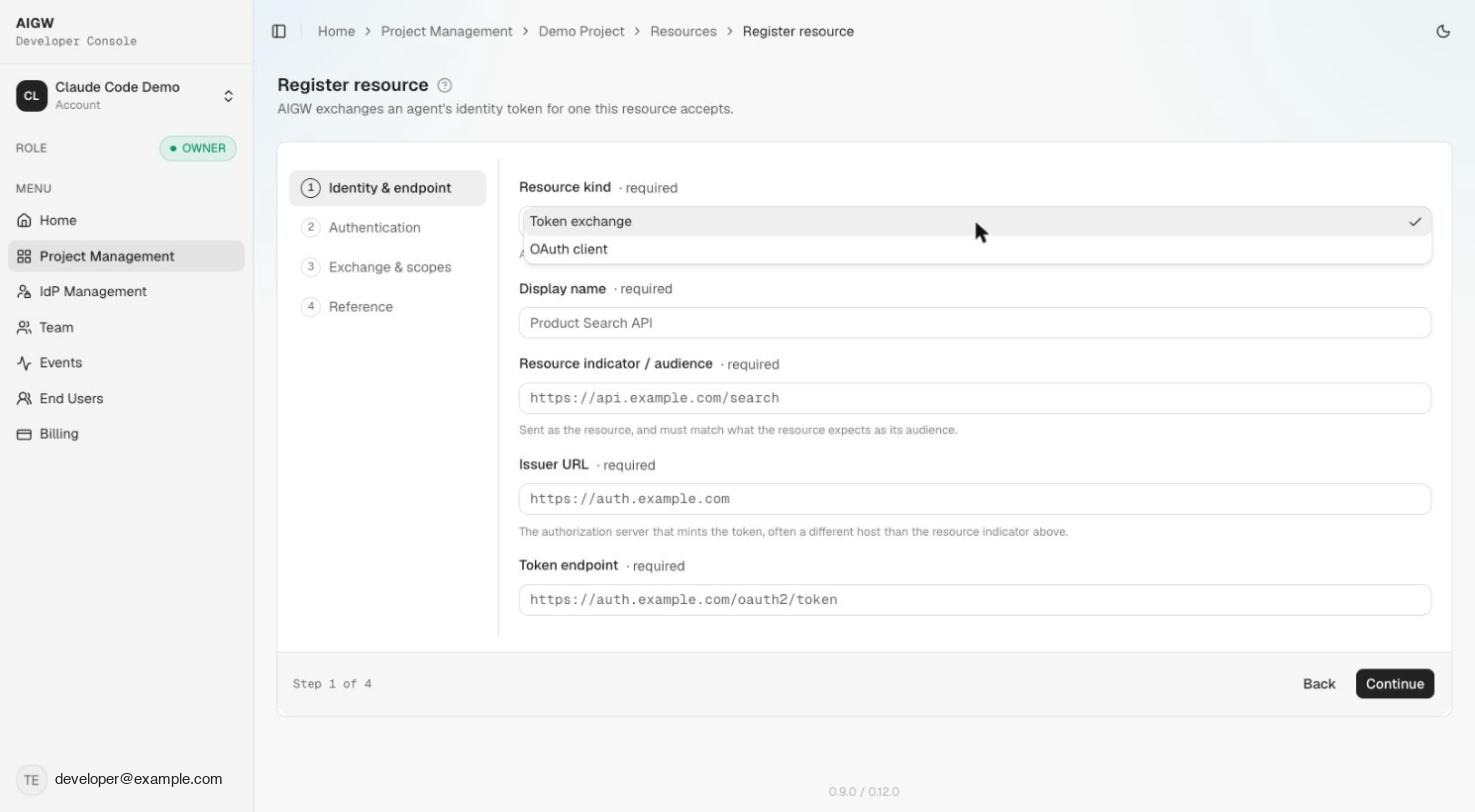
| Resource kind | Primary scenario | AIGW's role | Typical developer |
|---|---|---|---|
| Token exchange | Agent acts through MCP/UCP on behalf of a user and ultimately needs access to a merchant API | AIGW handles user/agent authorization and obtains/manages a merchant access token accepted by the merchant's Authorization Server/API | MCP/UCP provider or merchant building an agent-facing service |
| OAuth client | Traditional human sign-in to an application | AIGW acts as the application's IdP/authorization service and gives the application OAuth/OIDC client configuration | Web/mobile application developer |
Building an MCPMCPModel Context Protocol: a standard way for AI agents to call tools and data sources exposed by a server./UCP for agent access? → Token exchange
Adding human sign-in where AIGW is the IdP? → OAuth client
Token exchange Resource
Use Token exchange when the downstream merchant API has its own authorization system and the MCP/UCP service needs a merchant credential representing the authorized user.
Conceptually:
The Resource tells AIGW:
- which merchant Resource is being requested;
- which merchant Authorization Server/token endpoint to use;
- which client identity AIGW uses there;
- which authentication/grant mechanism to use;
- which scopes/permissions are relevant;
- which AIGW identity providers may authenticate the human user.
Wizard steps
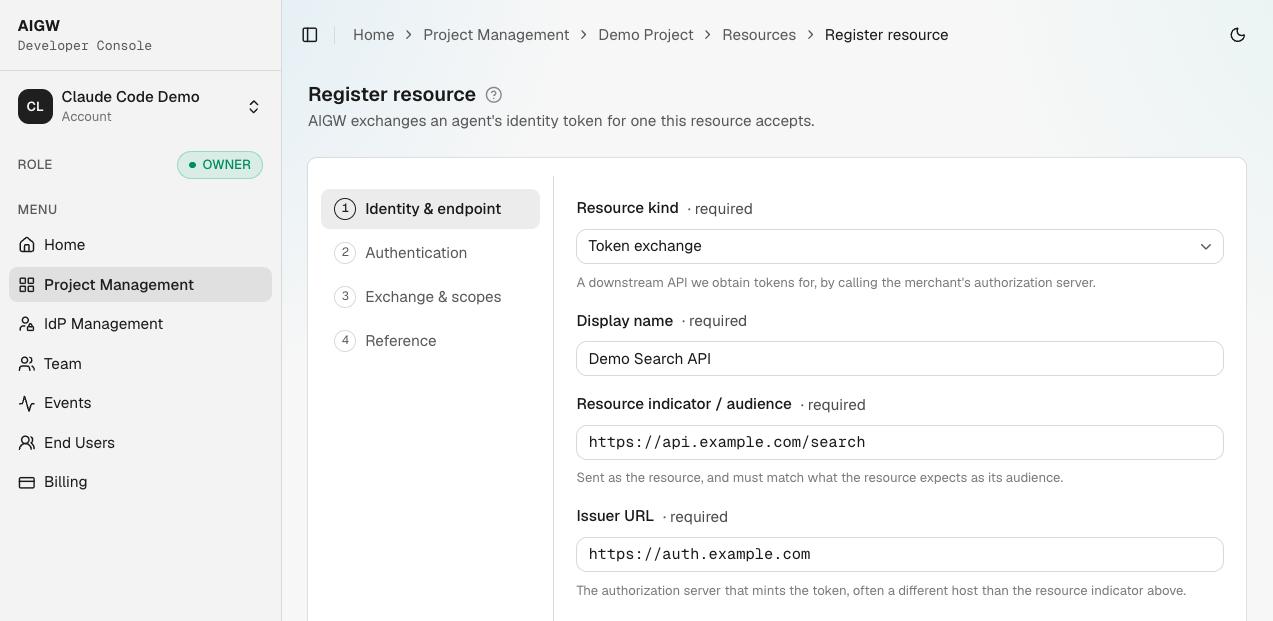
| Step | Fields |
|---|---|
| 1. Identity & endpoint | Resource kind, Display name, Resource indicator / audience, Issuer URL, Token endpoint |
| 2. Authentication | Client ID, Client authentication (private_key_jwt, client_secret_basic — which adds a Client secret field — or token_exchange) |
| 3. Exchange & scopes | Identity providers (optional), Requested scopes (scope value, display name, display description) |
| 4. Reference | Values to hand to the merchant IAM team and the agent developer |
Important inputs
| Input | Source | Purpose |
|---|---|---|
| Resource indicator/audience | Merchant API/IAM owner | Exact downstream Resource identifier. The Console notes it is sent as the resource and must match what the resource expects as its audience; later used during credential redemption |
| Merchant issuer URL | Merchant OAuth/OIDC metadata | Identifies the merchant Authorization Server (often a different host than the Resource indicator) |
| Merchant token endpoint | Merchant OAuth/OIDC metadata | Endpoint AIGW calls to obtain/exchange the downstream credential |
| Client ID | Merchant IAM client registration | Identifies AIGW to the merchant AS |
| Client authentication | Agreed with merchant IAM | Determines how AIGW authenticates and represents the user |
| Scopes | Merchant API/IAM | Defines requested downstream permissions |
Reference outputs
The Reference step (and the bottom of the Resource's Configuration tab) groups outputs by audience:
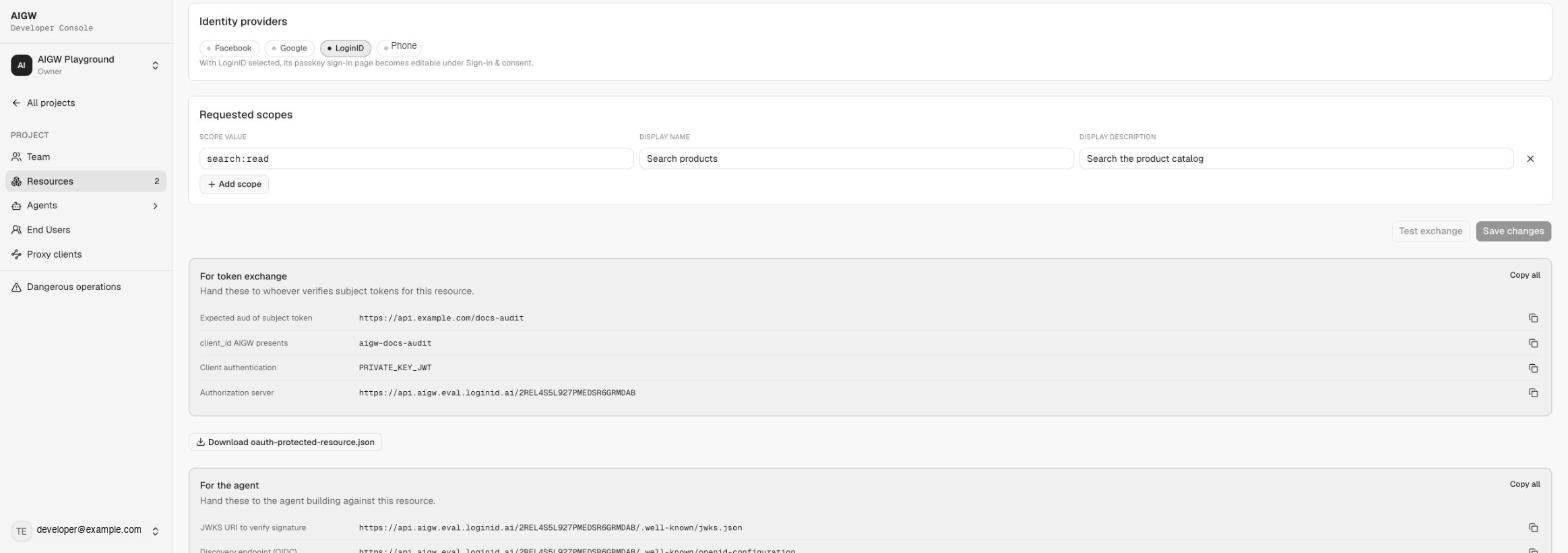
| Group | Values |
|---|---|
| For token exchange — hand to whoever verifies subject tokens for this Resource | Expected aud of subject token, client_id AIGW presents, Client authentication, Authorization server (per-resource issuer). Plus Download oauth-protected-resource.json. |
| For the agent — hand to the agent developer | JWKS URI to verify signature, Discovery endpoint (OIDC), Discovery endpoint (OAuth AS metadata), OAuth2 authorization endpoint (GET, per-resource), OAuth2 token endpoint (POST, core) |
Each section has Copy all and per-value copy buttons.
See Configure AIGW for field-by-field setup and current implementation support.
OAuth client Resource
Use OAuth client when a conventional application wants to authenticate a human through AIGW. In this model, AIGW is the IdP/authorization service for the application rather than a bridge to a merchant Authorization Server.
Conceptually:
Wizard steps
| Step | Fields |
|---|---|
| 1. Identity & endpoint | Resource kind, Display name |
| 2. Client configuration | Redirect URIs (one or more), Token endpoint auth method, Allowed scopes |
| 3. Identity providers | Optional selection of Account-enabled IdPs |
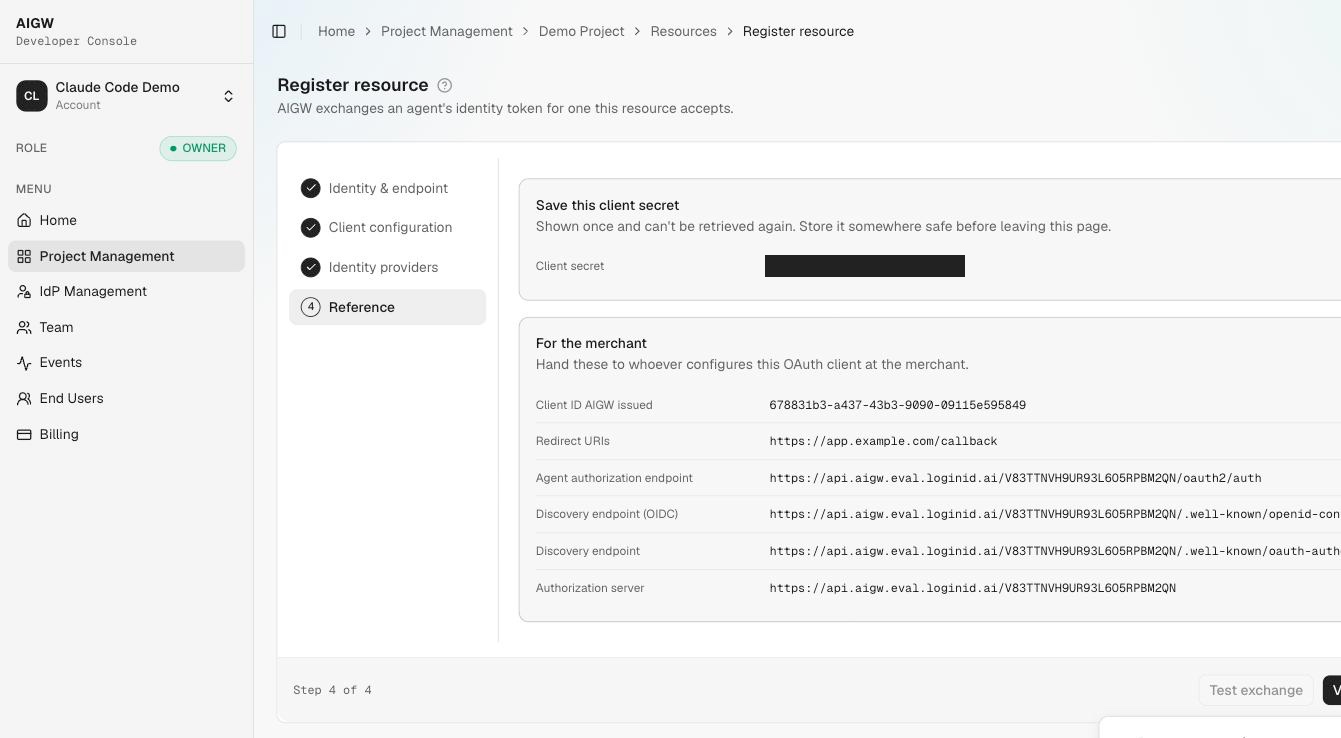
| 4. Reference | Client secret (shown once) and the values for the application |
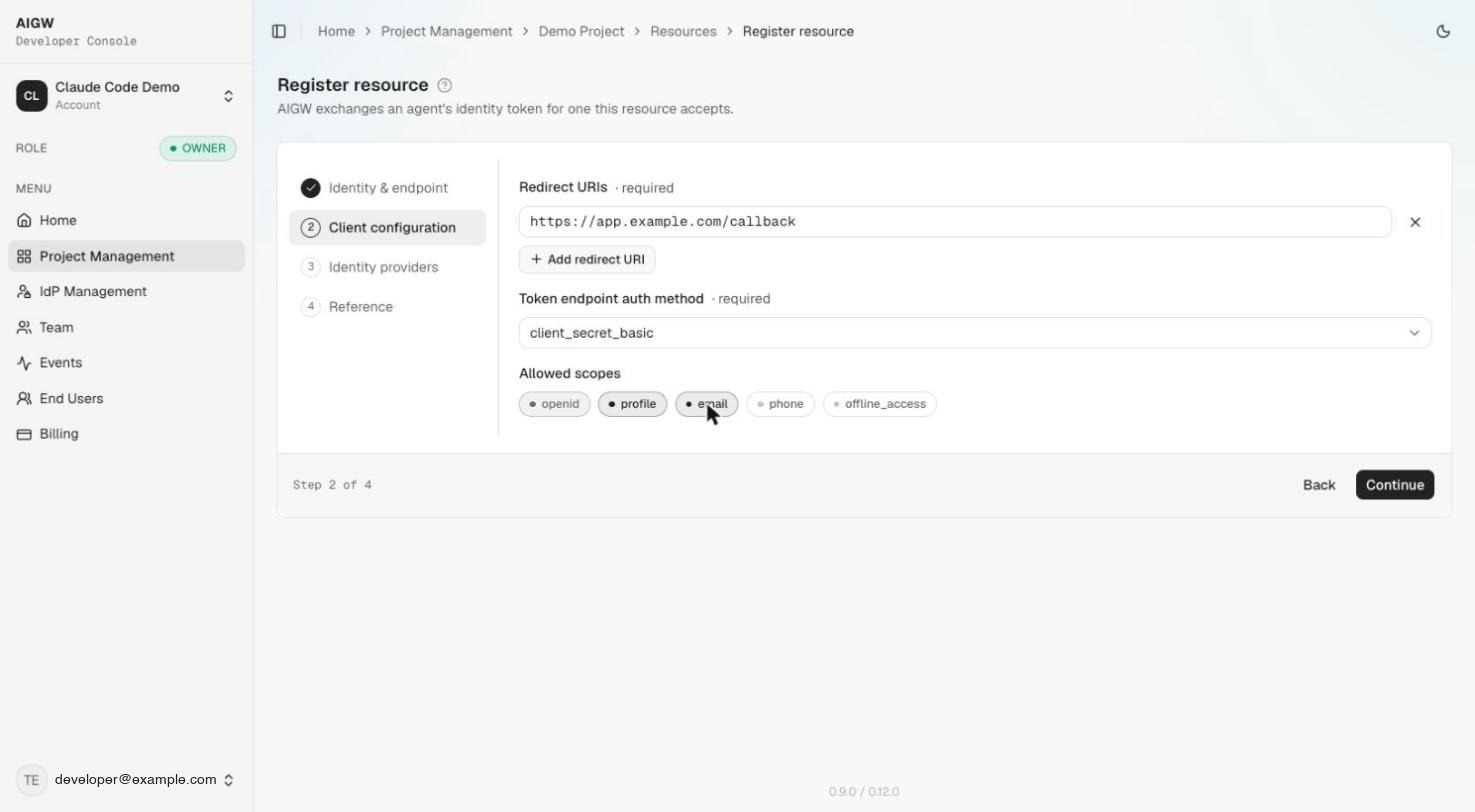
| Input/choice | What it means | Where it comes from / how to use it |
|---|---|---|
| Redirect URIs | Application callbacks allowed to receive the authorization response | Your application; register each exact callback URL (Add redirect URI for more than one) |
| Token endpoint auth method | How the application authenticates when calling the token endpoint: client_secret_basic, client_secret_post, or none (PKCE) | Use none (PKCE) for public clients (SPA/mobile) and a secret-based method for confidential server-side clients. Shown read-only after creation |
| Allowed scopes | Identity information/permissions the application may request: openid, profile, email, phone, offline_access | Choose the scopes the application needs (openid is selected by default) |
| Identity providers | Ways the human may authenticate through AIGW | Select AIGW IdPs appropriate for the application |
The Reference step returns the OAuth client information and AIGW endpoints the application needs.
Outputs
| AIGW output | What it is | How the application uses it |
|---|---|---|
| Client secret, when applicable | OAuth client credential — shown once and can't be retrieved again | Store server-side immediately and use only with the configured client-authentication method |
| Client ID AIGW issued | OAuth client identifier | Sent in authorization/token requests |
| Redirect URIs | Echo of the registered callbacks | Confirm they match the application |
| Agent authorization endpoint | Per-resource /oauth2/auth URL | Start sign-in |
| Discovery endpoint (OIDC) / Discovery endpoint | Per-resource .well-known/openid-configuration and .well-known/oauth-authorization-server | Discover protocol metadata (including the core token endpoint) |
| Authorization server | Per-resource AIGW issuer base URL | Configure as the OAuth/OIDC authority |
Resource list
ProjectProjectThe isolation boundary for an integration. It holds Resources, agents and agent policy, end users, and Proxy clients. → Resources lists each Resource with its kind badge, status (Active), and a summary: the token endpoint and client authentication for Token exchange ResourcesToken exchange ResourceA Resource for agent access: AIGW authorizes the user and obtains a token from the merchant's own authorization server., or the client ID, redirect URIs, and auth method for OAuth client ResourcesOAuth client ResourceA Resource for ordinary human sign-in, where AIGW acts as the application's identity provider..
Resource settings after creation
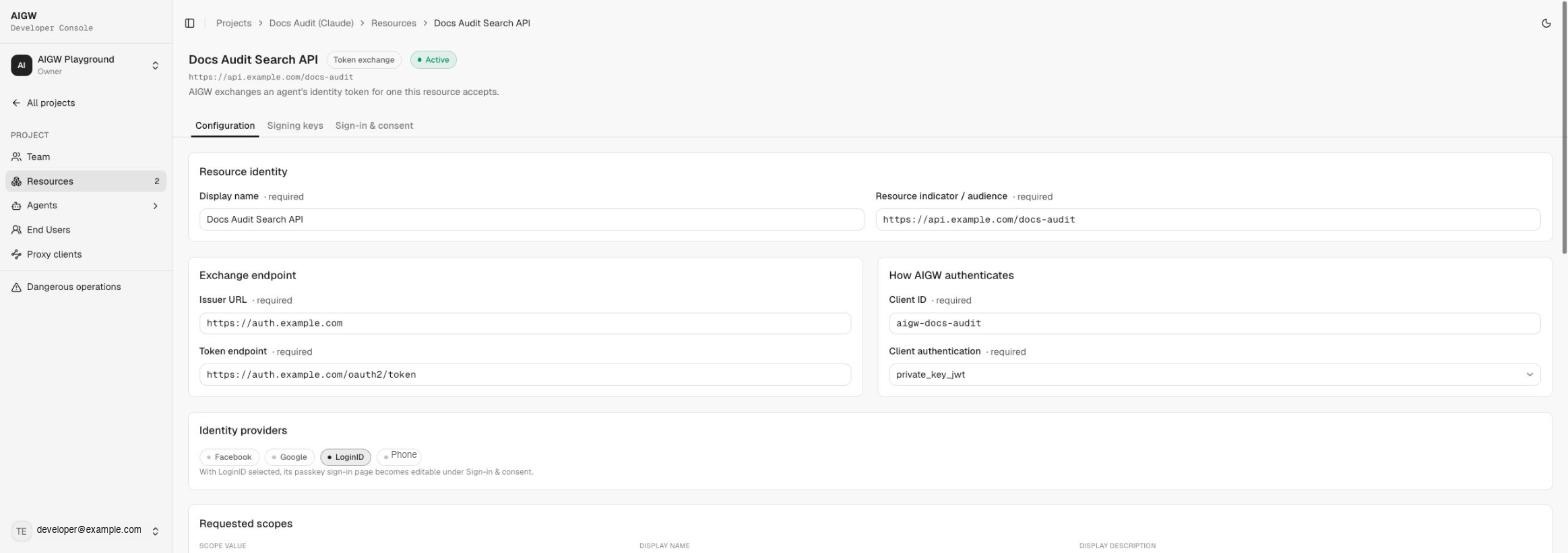
A Resource detail page has three tabs:
- Configuration — editable identity, endpoint, client, identity-provider, and scope settings, followed by the Reference values and a Danger zone with Delete resource;
- Signing keysSigning keyA per-Resource ES256 key AIGW uses to sign assertions sent to the merchant authorization server, published at the Resource JWKS URL. — ES256 signing keys/JWKS used for Resource assertions (see Signing keys);
- Sign-in & consent — user-facing branding/consent behavior (see Identity providers).
Current behavior to be aware of:
- The Resource is created when you click Continue on wizard step 3; step 4 displays Reference values. A signing key is generated automatically at the same time.
- A Test exchange button appears on the Reference step and the Configuration tab, but currently produces no visible result.
- Deleting a Resource is permanent: agents using it can no longer exchange tokens for it.